© Marco Monaldi — All rights reserved
CRITICS

FROM THE BODY TO THE SACRED. FROM THE SACRED TO HUMAN MATTER
BY LOREDANA FINICELLI
BEYOND. HUMAN BEINGS
BY LOREDANA FINICELLI
SILENTIUM
BY RAUL CÓRDULA
As he explores the creative labyrinth through which every artist passes in the course of personal development, Marco Monaldi repeatedly encounters adamantine presences: beings that may appear angelic at a glance, yet reveal themselves as profoundly human under closer observation.
Monaldi’s human angels are the constant thread of his artistic enquiry. They are his mirror, his touchstone, the standard of comparison and reference against which he has measured himself since the beginning of his painting practice. Like the artist, first an inexperienced young man and later a mature adult, these angelic presences have gradually developed. The imperfect being, longing for the absolute and the universal yet drawn to the dark, unsettling paths of the unconscious, and above all to the human soul’s unspoken desires, seems to free himself from those shadowy shores and ascend towards clearer dimensions. In these works, the outlines of the human angels become even more precise and meticulous, insofar as that is possible in painting already so committed to drawing and line. Every muscle, every tendon, every anatomical element is rendered with the assurance of someone who understands the secrets of bodies: the arrangement of masses, the interplay of solids and voids, the countless variations of the skin. This descriptive knowledge is necessary to the construction of these sculptural, composed poses, in which the body is tested through unnatural and deliberately contrived positions. Everything serves the virtuosity of an artist who is both enchanter and magician, delighting in his compositional skill and his command of painting, while reminding us that all this is only a symbol, a metaphor for the difficult, uneven path towards a new dawn. For it is indeed a new dawn, a renewed awakening, as the divine reveals itself, intangible yet evident, to these imperfect beings reaching towards infinity. The sacred is revealed in the transparent currents that flow across the canvases and brush against the bodies of these unfinished angels, as though seeking to bind and envelop them.
The dialogue with the divine essence finds its fulfilment here. Like a magical epiphany, it takes on the character of colour, towards which Monaldi seems finally to move with caution, discretion and perhaps excessive restraint. For an almost monochromatic artist, the redeeming divine can only possess the brilliance of colour and the texture of light. Colour returns as the sole conspicuous note in the paintings of male faces. Faces of men searching, faces of men on a journey: faces whose gaze breaks sharply away from the image and strikes the viewer like a slap. “Have you tried? Have you attempted it?” Above all, “Have you searched, human being?” These questioning, penetrating eyes seem to ask, painted with the skill of a miniaturist and the insight of a perceptive observer.
Angels or otherwise, the Marche artist’s men who reach beyond, all-too-human beings painfully capable of improvement, complete their evolution in these works and arrive at their final metamorphosis. An encounter has taken place with the spirit that makes amends for everything and resolves everything. And finally brings everything to a close.
Ariel is the 54th of the 72 angels who make up Jacob’s Ladder. According to Christian Kabbalistic tradition, he guides those under his protection towards a union of feeling and reason, so that they may understand the mysteries of the celestial world. He asks them to illuminate, with their own light and fire, the path that will lead them to a new world of peace and happiness.
Marco Monaldi paints this angel enveloped in white flames, evoking silence through painting without colour, or rather through colour understood as the synthesis of light, white, and of matter, black. Silentium is the pilgrim’s condition in the search for the eternal; it is the triumph of beauty over the ineffectual, the gateway to the soul.
Marco is an Italian painter who graduated with honours in painting from the Academy of Fine Arts in Florence, with a thesis entitled “The Modern Angel”. His pursuit of perfection may cause his painting to be mistaken for the hyperrealism so fashionable in the 1970s, yet there is nothing realist about his art: it is transcendental.
For several months he has lived and worked in Olinda, as part of the entrepreneurial group offering us this new venue, a home for various arts, including gastronomy, music, the visual arts and others still to come.
Olinda, May 2015
Raul Córdula
Marco Monaldi is an artist who goes against the grain. He challenges prevailing trends in contemporary art, shared conventions, and the critical approaches through which artistic practice usually interprets reality today. He can do so because he has an exceptionally clear command of traditional artistic tools: few artists draw with such mastery, and his understanding of space seems almost limitless. With these solid foundations, he creates a self-assured figurative art of considerable emotional impact, at once evocative and compelling. His painting unfolds at a slow, measured pace, with restrained, meditative tones and an almost sublime atmosphere. It might be described as close to the sacred were it not so attentive to human nature, to its bodily aspects and its most pronounced physicality. In his visual language, the body, with its polished, sharply articulated anatomy, is as significant as the references to transcendence. This irreverent tension between the human and the divine provides the key to his painting.
Part of Monaldi’s work is devoted to angels, although these beings are too human and too fallen to be entirely credible as spiritual essences. They are much closer to the earth than to the heavenly realm. These angels are deeply human, and these humans deeply flawed; nevertheless, they meditate on their own imperfect and vulnerable nature, a condition ultimately shared by all human beings.
This seems to be the proposition advanced by Monaldi’s work. An outstanding draughtsman trained at the Academy of Fine Arts in Florence, that remarkable workshop of talent, he can express himself through the full range of painting’s means, from drawing to oil painting. In oils, he reaches extraordinary levels of accomplishment, evident in his precise anatomical knowledge and his spatial command of bodies, usually depicted in dramatic, almost unnatural foreshortening. His work also includes engravings, in which his clear line takes on a vibrant, mysterious atmosphere, echoing ancient secrets.
His choice of monochrome amplifies the qualities of his drawing and the expressive force of his marks. Less immediately seductive than colour, this approach reveals the painting’s internal rhythm as a sequence of lines and volumes. It brings out a cool, insistent contrast of light and dark, crucial to the overall perception of the image and its meaning.
The charged theme of human angels is the guiding thread of Monaldi’s painting and the centre of his artistic reflection. Yet he also explores less intellectual genres, more accessible to viewers who may be less familiar with monochrome painting, which heightens drawing while tempering immediate emotional response. If his work lacks anything, it is the tendency towards simplification so widespread today: that levelling down of perceptual experience which reduces everything to the easy and elementary. Instead, it ambitiously stretches the possibilities of traditional techniques to the limits of the conceivable. His curiosity as a draughtsman and close observer of nature therefore also finds expression in floral subjects. These are works of great virtuosity, yet far removed from easily approachable naturalistic realism. Monaldi’s flowers are made of the same substance as his angels. Like them, they inhabit an estranged, almost tragic atmosphere, boldly foreshortened, their twisting forms observed as though they were bodies under tension rather than the stems of flowering plants. Examples of a virtuosity beyond time and history, these floral works are the one genre in which Monaldi introduces colour, albeit cool and radiant: an artist in whose work tradition regains its intensity and modernity takes on the forms of dramatic evocation.
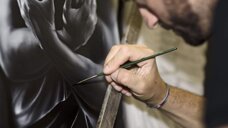
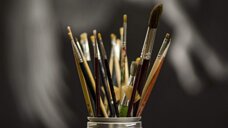
DE HUMANA NATURA
BY SERAFINO CAGGIANO
MONALDI AND REALITY
BY PAOLO MARIO GALASSI
REALITY OR NON-REALITY
BY LOREDANA FINICELLI
When a person speaks,
we can observe the movement of their limbs
and listen to their words;
but how can we enter their thoughts,
and how can we reach their heart?
Confessions, Saint Augustine
Marco Monaldi’s art and figurative exploration appear to grapple with one of the subjects that Kant placed within the realm of the “noumenon”: that which cannot be truly known. The soul cannot know its own identity, but can only experience it.
This is the search of a soul that meditates visually, examines itself, falls, surrenders, rises again and struggles within its own consciousness. It captures moments of existence that emerge as epiphanies: openings in which consciousness perceives the tension of a self reaching towards the Absolute, alongside an awareness of the gravity that draws it elsewhere.
In one series, the human figure, rendered with sculptural force and with its body and face partly or entirely concealed from the viewer, wears an unsettling mask. This seems to allude to the support provided by the social roles we assume in an attempt to hold together a fragmented consciousness, whose only profound, unifying witness is the intimate and solitary light of awareness.
Angelic figures fallen from eternity into this earthly realm, touched by a veiled eroticism, reveal their humanity. Moving through an indistinct process of falling, awakening and acceptance, they strive, through light, to recover a path towards a transcendent dimension.
The natural forms in the floral paintings are removed from everyday reality and, like the bodies, cast into another, undefined realm. Their luminous, brilliant colour may be a spiritual metaphor for the soul as an expression of precarious, fragile beauty.
The artist’s enquiry seems to reveal a shared condition: the effort common to anyone engaged in an introspective, spiritual or religious search for an identity never fully defined, suspended between heaven and earth.
The 2009 Venice Biennale, currently underway, marks a turning point in the distinguished history of this international exhibition.
For the first time, faint signs of reflection can be discerned on the artistic expressions of previous years. To speak of a reassessment would still be premature: it is a reflection on their validity, their value, their language and their capacity to communicate.
Whether this cautiously chosen path will lead to remarkable results remains unknown. The coming Biennales will need to be followed closely before we can take the measure of contemporary art worldwide.
The Italian Pavilion, in particular, has attracted visitors’ attention, perhaps precisely because it pioneers this new artistic season while celebrating the anniversary of a movement from the past: Futurism.
This extended reflection is necessary to place Marco Monaldi’s work in context.
A painter from the Ascoli area, he understands art as an expression of reality, but not as a photographic instant, itself an undisputed art form. Instead, it is a reality within which the human being exists: genuinely human, genuinely real, in other words, true to oneself in one’s spirituality within one’s material existence.
Pure form, the form nature has given us and, for the believer, an expression of the divine, needs no embellishment that would merely burden it with the unnecessary.
It need only be contemplated so that it may return to the viewer and enrich their spirit. One might say that this very purity of form binds together all reality, understood as nature in its pure state.
Marco Monaldi’s canvases possess the strength of someone who draws the true essence from nature and transmits it to the viewer through a process of osmosis.
The scale of the canvases itself invites viewers to participate in this reality as an essential fragment of a harmonious whole, to enter the reality that the painter reveals in its essence.
Within this context, the figures, impeccable in technique and chromatic structure, free themselves from human constraints and move into an unbounded universe. The angel itself, with wings white with purity, unites the divine and the human in a single figure, suggesting that when the human being is, or becomes, free, they will approach reality: the true reality from which they began.
Reality thus becomes non-reality because it has attained purity.
Following this path, Marco Monaldi is ready for a Venice Biennale.
Critical essay: Reality or Non-Reality
Novae vanitates
Like modern vanitas images, the subjects of Marco Monaldi’s works shine with an apparently authentic, polished beauty, their qualities poised between the true and the plausible.
Human beings, human angels and flowering plants, or history, what lies beyond history, and nature, form this artist’s limited yet effective range of subjects. They remain suspended between human and divine actions, equidistant from heaven and earth.
Both the fragments taken from the plant world and the athletic human and more-than-human figures share the same crystalline stylistic character. A skilled sculptor of forms and volumes, increasingly fluid and naturalistic, Monaldi plays with shapes modelled by accomplished chiaroscuro, boldly orchestrating an intense, carefully judged contrast of light. Bodies emerge in the foreground, emphasised by white, raking light, asserting their compact forms and concentrated masses: perfect ideas of bodies and other beings before they are actual humans or angels.
Similarly, the Marche artist’s still lifes belong more to the world of abstract concepts than to nature as it exists. They are fully realised archetypes, models from a distant memory embedded in a centuries-old consciousness. They, too, belong to the realm of living bodies, no less than the humans, sometimes angelic and sometimes less so, of the other paintings.
His works are distinctive serial representations. Like an obsessive scholar engaged in a complex ars combinatoria, Monaldi assembles different versions of the same subjects, changing their poses: from the side, from behind, then from below or above. It is as though every unfamiliar view, every overlooked profile contained a secret to trace, something unspoken to reveal, a detail to recover or a fold of clothing to arrange.
Monaldi’s garments are neither naïve nor accidental choices. They are not harmless day suits or elaborate evening dress. They are leather garments for those who bear their intrinsic substance and draw nourishment from their polished reflections, charged with mystery and power. Like the masks in certain paintings, they evoke a truth that is not actual, an authenticity that is not original, and certain underground avenues where men and women briefly lose their imperfect identity and live through minute dreams and precariously balanced emotions.
Perhaps these humans and other beings are searching for a spiritual realm that has now definitively receded, exploring the paintings’ chromatic outskirts, dominated by the extreme colours of the unreal, absent from nature: black and white, tinged with alluring greens and reds that flame in more than name alone.
Red, like the woollen clothing of Spartan warriors. Like the purple-bordered robes of the Caesars. Like the vibrant fluids of life. Green, the confused, tangled green of hope, struggles through the backgrounds of the first series of human angels and dominates the successive still lifes, breaking the single-minded pattern of white, which unites everything, and black, which erases everything. Black and white, like the obsession of a Pythagorean mathematician for whom chromatic variation produces the anxiety of suggestion and releases a torrent of sensation.
Within these perfectly staged theatrical representations, evoked by the draped backdrops of some paintings and the unsettling masks of others, Monaldi stages the theme of postmodern vanitas while concealing it from the viewer. It is a salutary warning with ancient roots, often hidden within excessive beauty or overly polished perfection.
This ethical formula was inherited from the complex Baroque period, when still lifes on the threshold of hyperreality alluded to life’s transience, the vulnerability of beauty and the inexorable flow of time. Monaldi adopts this warning and conceals it beneath his attractive images, themselves sometimes pushed to the limits of artifice. Yet unlike seventeenth-century paintings, in which warnings were entrusted to recognisable details or allegories decipherable by informed viewers, these paintings do not put heaven and hell, everlasting salvation and eternal damnation at stake. His allusion becomes subtler and more ambiguous, and at the same time, because it is less readily understood, more troubling.
What is at stake is neither guilt nor sin, but mature human awareness and its relationship with the spiritual realm: emancipation from an all-too-human condition that forgets the divine yet continues, despite everything, to reach towards it. This generates an underlying movement from the human towards the angelic, which all too often turns back.
An excessively adventurous human nature, caught between the need and the demand for the absolute, and an earthly satisfaction that is never complete.
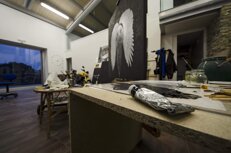
OUT OF THE DARK
BY GIANLUCA MARZIANI
Galleria Fanelli by Artsinergy
October 2008
The painting follows two parallel paths that intersect elegantly and subtly: portraiture on one side, floral nature on the other. They are brought together through an ambiguous sense of gender, in which sexuality occupies the image’s hidden heart. The young men portrayed have angels’ wings, athletic bodies and introspective poses. Their gestures resemble those of long-stemmed flowers: they droop or emerge from their torpor, moving their torsos and arms like orchids or tulips. Bodies and flowers enter a subtle pictorial symbiosis in which humanity and nature rediscover the form of desire. Painting becomes silent and nocturnal, a kind of backdrop in the darkness from which solitary, compelling forms emerge.
©2022-Marco Monaldi all right reserved